
News
Find out about the latest news, announcements and stories about science and medicine at ANU.
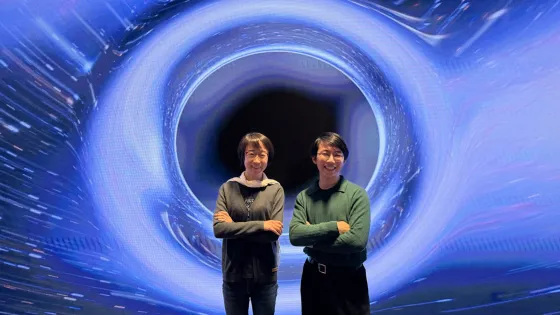
Scientists find a way to study the event horizon where light and sound are swallowed for eternity
If, in space, no one can hear you scream – it seems that you can actually hear the sound of a crash when two black holes collide.
Read the article
- Analysis and opinion
What are nanobubbles and why would they be used to address an algal bloom?

- News
If, in space, no one can hear you scream – it seems that you can actually hear the sound of a crash when two black holes collide.

- Research story
Should we stop viewing ignorance only as a problem? In his new book, Emeritus Professor Michael Smithson explores why psychology needs to pay more attention to what we don't know. Arguing that ignorance can not only be bliss, but also an important part of what makes us, us.

- News
An international team of researchers has detected rare radioactive isotopes in a deep-sea manganese crust, providing new insights into the formation of the heaviest elements in the universe.

- News
Researchers have uncovered a mechanism that helps plants continue photosynthesising under extreme heat and dry air conditions.

- Staff profile
Associate Professor Anne Brüstle is a passionate advocate for Inclusion, Equity, Diversity and Access (IDEA), both at ANU and within the broader community. Discover how collaborating with people with Multiple Sclerosis has enriched her research career and why fostering a university culture where everyone feels valued, respected, and empowered to succeed is vital for our future.

- Research story
As Australia expands its ambitions in nuclear technologies, Associate Professor Elizabeth Williams says the country is grappling with a question that doesn’t have a simple answer.

- News
Emeritus Professor Malcolm Sambridge has a knack for solving the unsolvable. His pioneering work developing mathematical models to solve earth science problems has seen him elected as a Fellow of the Royal Society.

- Research story
Professor Lan Fu is using nanotechnology to develop a medical device to detect signs of diabetes.