

Physics
About
The ANU Research School of Physics constitutes Australia’s largest university-based physics research activity, incorporating major national facilities, national networks, a significant technical manufacturing and prototyping capability, as well as an innovative teaching program.
Our research activity includes nonlinear and quantum optics and quantum systems engineering, soft and hard condensed matter physics, III-V semiconductor physics, nano-engineered and meso-scale materials, nuclear physics, novel imaging technologies and plasma science.
Our researchers have played important roles in some of the most significant breakthroughs in physics, including proving the existence of gravitational waves in 2016.
The observation of a gravitational wave, ripples in space caused by the collision of two black holes, confirms a prediction made by Albert Einstein's General Theory of Relativity 100 years ago, and opens up new fields in physics and astrophysics.
The important role that our researchers played included constructing, installing and commissioning crucial components of the detectors used by the Laser Interferometer Gravitational-wave Observatory (LIGO) in the United States.
Fundamental and applied research, just like this, also sparks the development of novel technologies and have seen a number of successful spin-out companies go global.
In 2009 Lithicon, then named Digitalcore, spun out of the Research School of Physics and Engineering. The big commercial step was taken after 10 years of fundamental research by ANU scientists. Their research combined novel scanning technology and advanced computer algorithms to produce high-resolution 3D images and simulations of fluids in oil reservoir rocks.
Fast forward to February 2014, and Lithicon was acquired for $US8 million by microscopic technology company FEI, cementing a very special research relationship with ANU.
Facilities

The Centre for Advanced Microscopy (CAM) provides state-of-the art microscopy and microanalysis equipment to researchers, students and industry partners.

The HIAF comprises one of the world’s largest 14UD pelletron accelerators and a superconducting “booster” linear accelerator (LINAC) housed and operated by ANU.

The 348-hectare ANU Kioloa Coastal Campus is one of Australia’s premier field stations, offering a diverse ecology which encourages research across all scientific disciplines.

The ANU MakerSpace is an initiative by the Research School of Physics and Engineering, where we know people learn by doing.

The National Computational Infrastructure (NCI) is home to the Southern Hemisphere’s most highly-integrated supercomputer and filesystems, Australia’s highest performance research cloud, and one of the nation’s largest data catalogues—all supported by an expert team.

The CPAS Podcast Studio is open to staff and students throughout ANU (not just scientists!) to record and grow podcast series. Your success is our success: we want to help you make the biggest and best podcast series in the world.
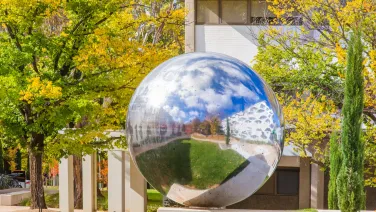
Our new $240-million science precinct on the ANU campus has state-of-the-art biological and chemical research laboratories, as well as a teaching hub.
News
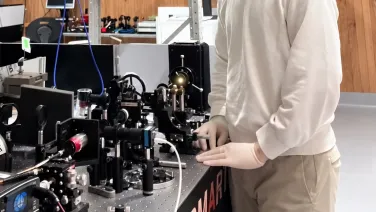
A new technique that allows optical components to be reprogrammed by laser light could open the way for a new generation of telecommunications and signal processing technology.

Professor Nanda Dasgupta and Professor Lan Fu have been recognised among Australia’s leading innovators in technology and engineering.

Making the advanced optics inside the most sensitive measurements of gravitational waves ever recorded.
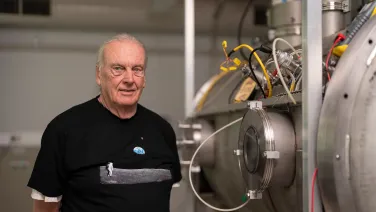
Professor Rod Boswell has been honoured for his invention of the helicon plasma source and more than five decades of innovation.

For a surgical procedure to result in patients being universally pain free, with zero recurrence of the ailment seems impossible - but that’s what’s been achieved by a new hernia analysis tool co-developed at ANU.

What are nanobubbles and why would they be used to address an algal bloom?