

Professor Nerilie Abram shares why Antarctica has captured her heart
There are two ways to travel as a researcher to Antarctica: by ship, or by plane. The slow, gradual journey, or the fast one.
Climate scientist Professor Nerilie Abram has experienced both during her exceptional career, across five different research expeditions to the remote southern continent.
“If you go by ship, then you have this long crossing of the Southern Ocean where you quite often experience some wild weather,” Professor Abram explains.
“You get this sort of gradual detaching from the real world back home, and some time to adjust and move into going to Antarctica.”
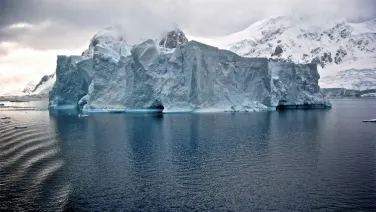
Spotting your first iceberg is really exciting, Professor Abram says. Then you gradually see more and more ice, until you eventually lay your eyes on the iconic landmass of Antarctica.
“The other way to travel is to have breakfast in Hobart and then you're having dinner at Casey Station,” Professor Abram laughs. “That’s a very different sort of mind shift.”
Regardless of how you travel there, Antarctica has a way of capturing people’s hearts.
Professor Abram is sitting down with me in her office at the ANU Research School of Earth Sciences, right before she embarks on a new career direction as Chief Scientist for the Australian Antarctic Division. It’s a good moment to reflect on what led her here, and her dedication to Antarctic science.

“It was after I did my PhD at ANU that I then got a job at the British Antarctic Survey, and that's what turned me to Antarctic research,” she explains. Her work has included climate research in the Arctic and the tropics, but mostly, it revolves around Antarctica. In 2024, her exceptional research led to her election as a Fellow of the Australian Academy of Science.
Antarctica is the only place on Earth where nations have declared through a treaty to put a whole continent aside for peace and for science. Professor Abram is very aware of that unique purpose when she’s working on Antarctic science.
“I find it very, very special and emotional to be there,” Professor Abram says. “It's weird. It's lovely. It can also be really intense.”
That’s largely because Antarctica offers up so many experiences at once.
“There's the moments where it's utterly quiet, and you're on an ice sheet just surrounded by white and snow,” she says. “You notice all the changes – like the surface of the snow around you and how it sparkles in the sun.”
There are the close connections you build with diverse teams of people.
“That's a joy as well, to spend time with people who are all having that same experience of living in this amazing place.”

As a climate scientist, Professor Abram’s research has required drilling deep core samples into sediment layers to find records of the Earth’s past, which she analyses to understand how the climate has behaved previously.
“I look at what that tells us about climate processes, what it tells us about how humans are changing the climate, and the context that gives to what we need to do about climate change as well,” Professor Abram explains.
In Antarctica, this research can involve some tough field work, but it’s the importance of research that keeps people going.
Recently, Professor Abram took part in one of the biggest and most ambitious research projects Australia has run in Antarctica: the Denman Glacier campaign. This interdisciplinary project required three summers of field work to learn about this vulnerable glacier and how fast it is melting.
Scientists and the project support team on the Denman Glacier campaign lived and worked in a remote campsite that was a four-hour flight from Casey Station. Some, like Professor Abram and her ice drilling team, were based in even more isolated satellite camps, moving every few weeks.
Camping in a small dome tent at staggeringly cold temperatures is not for the faint-hearted. But with a decent sheepskin rug under your high-quality sleeping bag, you make it work, Professor Abram says.
While sleeping on the ice for months may not be a part of her new role as Chief Scientist, Professor Abram has big goals for uniting the large and varied Antarctic science community in Australia.
“One of the challenges is: how do you bring together all of those pieces of expertise and put that together into a program to be able to deliver the science that we need and answer really important questions?”
These questions are so important because the changes that happen in Antarctica affect the whole world. Sea level rise, weather patterns and carbon levels, indicate a changing climate with global impacts, but the magnitude and the speed of these changes are less clear.

“The changes that we are seeing are quite worrying,” Professor Abram says. “There's a lot of science to do to determine exactly how quickly this part of the world might change, and what's that going to mean for the rest of the world.”
Given further challenges to scientific funding and research, particularly decreased support from the United States, Antarctic science needs strong advocacy.
Professor Abram never wants to take these research programs for granted.
“What has been set up for Antarctica is something really special. I hope that it's something that stays into the future,” she says.
That, and the incredible personal experiences she’s had, are always on her mind on the journey back after an incredible Antarctic trip.
“Coming home is hard,” Professor Abram says.
“Every time I've left Antarctica, I've always looked out the window and thought: I wonder if I'll ever be here again.”
Related content

In 2008, Nerilie Abram was a climate scientist working on ice cores at the British Antarctic Survey in Cambridge. On one memorable day, Prince Charles visited the facility – and Nerilie was tasked with giving him a tour.

Using historical records from around Australia, an international team of researchers have put forward the most accurate prediction to date of past Antarctic ice sheet melt, providing a more realistic forecast of future sea level rise.
Antarctica is at risk of abrupt and potentially irreversible changes to the continent’s ice, ocean and ecosystems.