
Clever projections conjure ghosts from the noise
When you are trying to draw the finest details of a design, every tiny flaw in your "pencil" counts.
But a team of physicists have found a way to take these flaws in your system and make them features.
“It turns out you can layer these chaotic, distorted patterns in just the right way to produce your desired image,” said James Monro, who explored the issue in his research project with the Department of Materials Physics (MP).
“It’s just like conjuring ghosts from noise.”
This approach is called ghost projection, said Mr Monro’s supervisor, Dr Andrew Kingston, from MP.
“Ghost projection allows us to overcome limitations from hardware, and even the physics of existing techniques. This helps us with beam shaping in scenarios where previously it has been very difficult, and could enable novel high-resolution capabilities beyond the limits of current techniques."
For example, to manufacture a transistor, you need to draw your desired microscopic design onto a photosensitive film using a beam of radiation, a process known as lithography. The smaller the transistor, the harder this becomes: diffraction and flaws in your system distort the result, rendering the product useless.
But the ghost projection leverages computational methods to turn the bad to good, harnessing features within the noise patterns.
It’s a hotbed of gothic-sounding terminology: alongside ghost projections, there are caustic lines, diffraction catastrophes and the Sierpinksi carpet.
But Mr Monro chooses a much less sinister analogy.
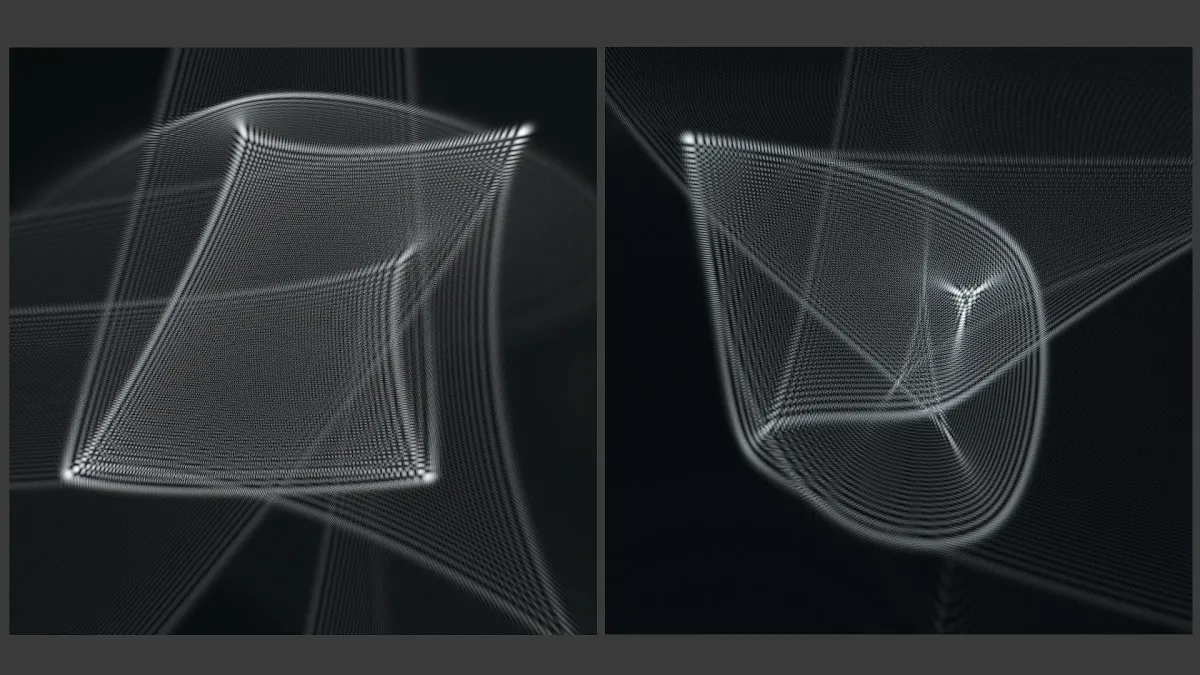
“It’s like the distorted patterns of light on the bottom of a pool, full of sharp bright lines produced by gentle undulations of the water surface. These pretty patterns turn out to be a surprisingly good basis for building detailed images," said Mr Monro, who published the research in Physical Review A, with co-authors Dr Kingston and Professor David Paganin from Monash University
Sinister or not, the team have created a method powerful enough to beat the usual limit for fine sources: diffraction – scattering caused by the wave nature of light.
The idea of ghost projection has been published before, using a mask to create the basis of patterns. Instead, the team proposed a maskless scheme in which the patterns are highly detailed diffraction patterns, known as diffraction catastrophes, produced by randomly varying the phase of the light across a beam cross section before focussing.
One advantage of diffraction catastrophes is that their sharp lines – called caustic lines – allow for projection of more detailed images. Diffraction causes sharply defined sources to blur into ring patterns, called Airy discs, but caustic lines can be thinner – enabling higher resolution than the Airy limit.
To test the ability of this technique to produce image features at many length scales, they set about to test their technique by projecting a detailed fractal known as the Sierpinski carpet.
The results indicated that any desired image could be created with the right combination of random diffraction patterns, so long as the random patterns are known and repeatable.
“I am constantly amazed when I watch ghosts (and other pictures) appear from the combination of random patterns,” Dr Kingston said.
“I hope this uncannily spooky, signals-out-of-noise method paves the way to next-generation computer chips and other applications."
This story originally appeared on the ANU Research School of Physics website.