
String Art and Parabolas
Summary
Degree programs
Research themes
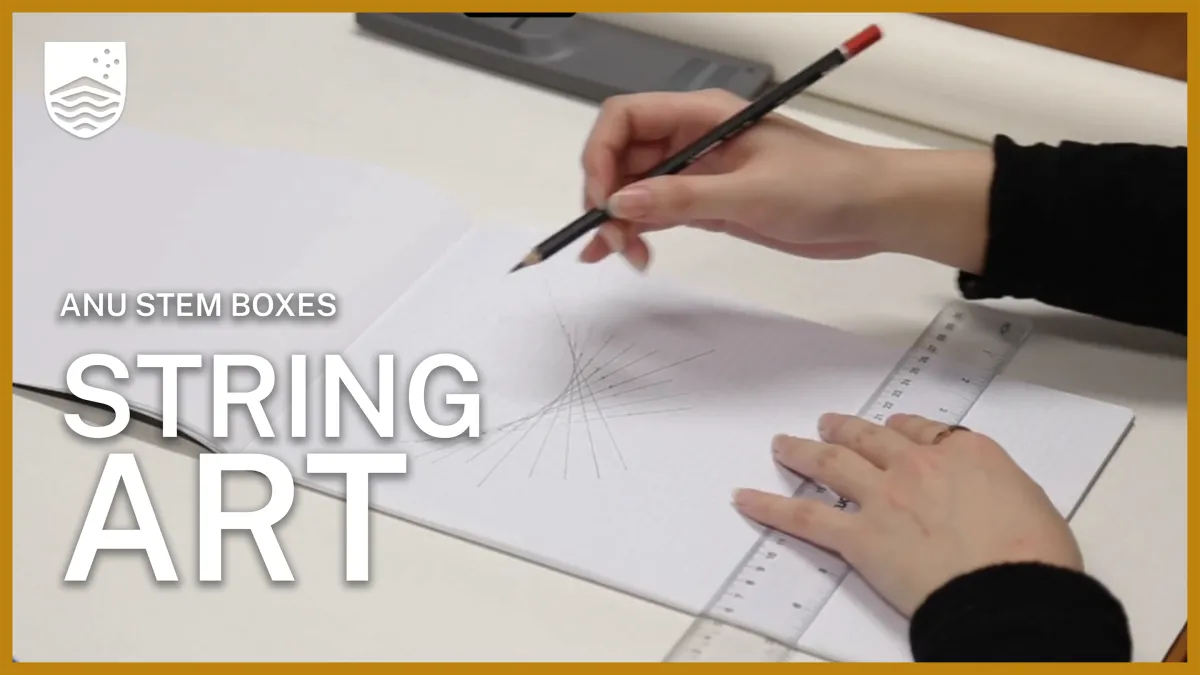
This activity is part of our Science Lab series. Check out the ANU Science Lab for more experiments and activities to try at home. In this activity, you will create parabolic curves using string art and paper folding. You will investigate how a familiar mathematical shape appears in many different ways and discover why the path of a thrown ball follows a similar curve. Watch the video above for a demonstration.
Materials
For this activity, you will need:
- Graph paper
- Plain paper
- Pencil
- Ruler
- Coloured pens or pencils
String art activity
Step 1: Choose your starting points
- On a sheet of graph paper, choose two points that are at least five grid squares apart.
- Make sure one point is not directly above the other.
- Draw a straight line connecting the two points and extend the line slightly past both ends.
Step 2: Create the pattern
- Starting from one of your chosen points, move one grid square down and one grid square to the right.
- Starting from the other chosen point, move one grid square up and one grid square to the right.
- Draw a straight line connecting the new pair of points.
- Repeat this process, moving the points in the same way each time.
- Continue until no more lines can be drawn.
Step 3: Explore different starting positions
- Create a second pattern using a different pair of starting points.
- Compare the shapes that appear.
- Look carefully at the curved edge formed by the collection of straight lines.
Paper folding activity
Step 1: Mark your paper
- Draw a straight line near one edge of a sheet of paper.
- Mark evenly spaced points along the line.
Step 2: Create the folds
- Fold one marked point so that it touches another point on the line.
- Press the fold firmly.
- Repeat using the remaining points.
- Continue until you have created as many folds as possible.
Step 3: Observe the pattern
- Open the paper.
- Examine the crease lines.
- Notice how a curved shape appears even though all the folds are straight.
How does it work?
The curved shape that appears in both activities is called a parabola.
Although the string art and folds are made from straight lines, the collection of lines creates the appearance of a smooth curve.
A parabola is an important mathematical shape that appears in many areas of science and engineering.
You can see parabolas in:
- The path of a ball thrown through the air
- Water spraying from a fountain
- Satellite dishes
- Vehicle headlights
- Some bridge and arch designs
More than 2,000 years ago, ancient Greek mathematicians studied parabolas using geometry. Later, mathematicians developed coordinate geometry, algebra and calculus to understand these shapes in greater detail.
Scientists such as Galileo and Newton used these mathematical tools to explain how gravity affects moving objects. This is why the path of a thrown ball often follows a parabolic curve.
One of the most surprising things about parabolas is that the same shape can appear in many different situations, including string art, paper folding, optics and motion under gravity.
Science fair project: Take it further
Once you have created a parabola, investigate how changing the construction affects the resulting shape.
- Compare different starting points in the string art activity. How does this affect the shape of the parabola?
- Test different spacings between the points. Does closer spacing create a smoother curve?
- Compare the string art and paper folding methods. Which produces the clearest parabola?
- Throw a ball and record its motion using slow-motion video. Can you identify a parabolic path?
- Research how parabolic mirrors are used in satellite dishes, telescopes and headlights. Why is this shape useful?
- Create a table to record your observations. Which method produced the most accurate parabola? What variables had the greatest effect on the final shape?
Enjoyed this experiment? Explore more hands-on activities on the Science Lab ANU YouTube channel.
Related content
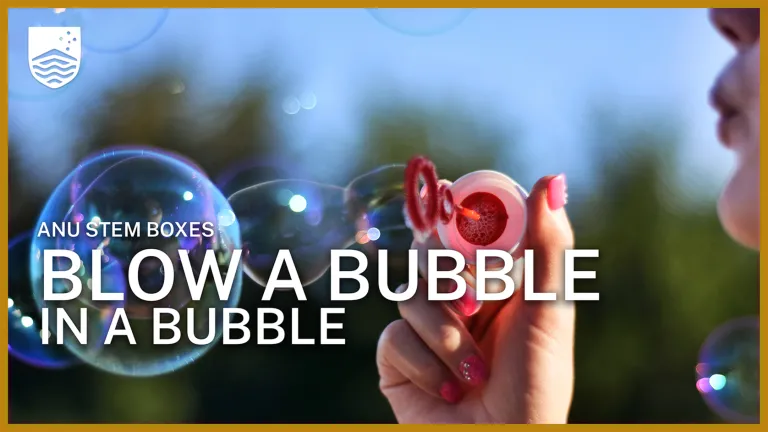
Bubble Wrangler Jesse shows us how to blow bubbles in a bubble and the science behind it.
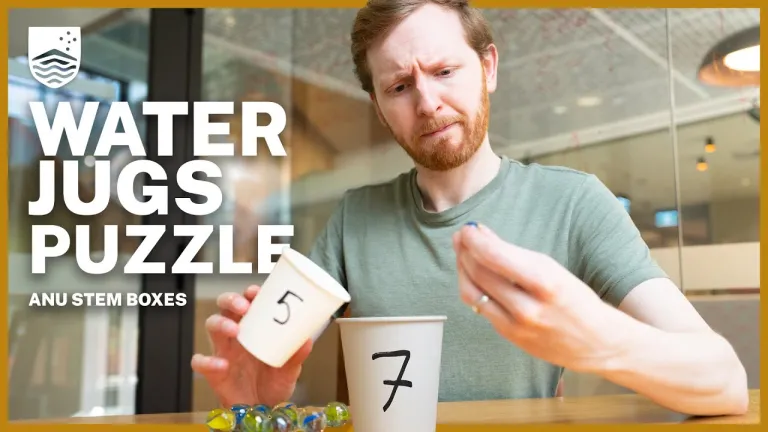
Dr Angus McAndrew walks you through the water jug puzzle.
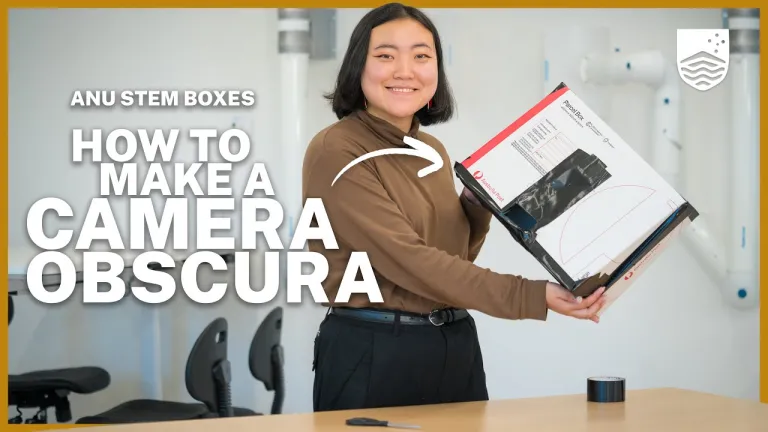
Unlock the magic of photography as Sandy guides you through making a pinhole camera (camera obscura) in this hands-on experience.