
How to build your own wind turbine
Summary
Degree programs
Research themes

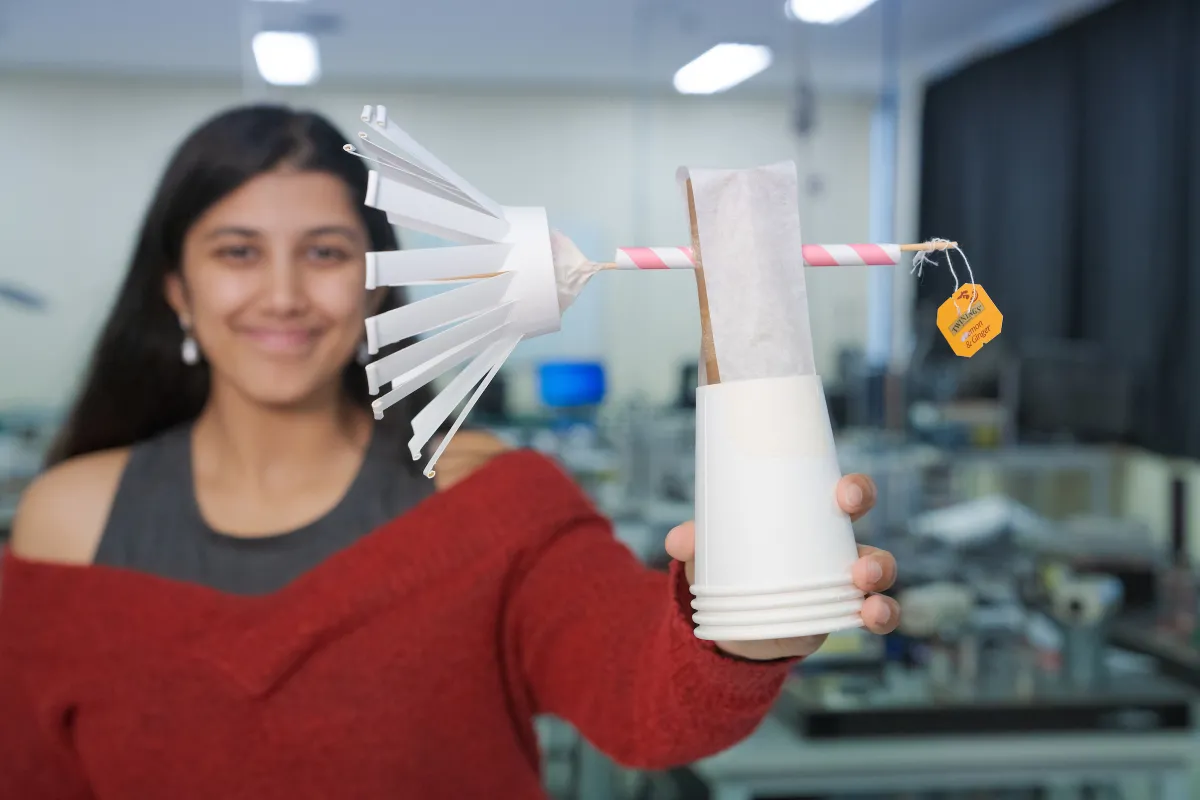
This activity is part of our Science Lab series. Check out the ANU Science Lab for more experiments! In this activity, you will construct a working model wind turbine using paper cups, skewers, and a cardboard tube to explore aerodynamics, rotational torque, and energy transformation. The aim is to use wind power to lift a small hanging weight and demonstrate mechanical work. Watch the video above to see how it is done.
Materials
For this activity:
- 2 small paper cups (one for the rotor blades, one for the base)
- 1 cardboard tube (such as a paper towel roll)
- 1 wooden skewer
- 2 paper straws
- Masking tape or sticky tape
- A piece of string (about 30 to 40 cm long)
- A small weight (such as a paperclip, washer, or small eraser)
- Scissors
- Hairdryer or electric fan (or your breath) to supply wind
Safety Note: Take care when using scissors or wooden skewers to pierce holes through paper cups and cardboard tubes.
How to build a wind turbine
Step 1: Make the turbine rotor blades
- Take one paper cup and make several vertical cuts down the sides from the rim toward the base to form individual blade strips.
- Gently fan the cut strips outward.
- Twist and angle each blade slightly in the same direction. Angling the blades allows passing air to push against them continuously rather than bouncing straight off.
Step 2: Assemble the axle
- Poke a small hole through the centre of the paper cup base using the wooden skewer.
- Cut two short pieces of paper straw (slightly shorter than the cup base diameter) and poke a hole through the middle of each.
- Slide the wooden skewer through one straw piece, through the paper cup base, and through the second straw piece. Secure the straw pieces firmly against the cup base with masking tape to keep the axle stable.
Step 3: Construct the base and mount the turbine
- Poke two aligned holes near the top of your cardboard tube.
- Insert a paper straw through the holes in the cardboard tube to act as a smooth bearing.
- Slide the back end of your wooden skewer axle through the straw in the tower base so the paper cup rotor spins freely at the front.
- Tape the cardboard tube securely to an inverted paper cup base for extra stability.
Step 4: Attach the weight and test
- Tie one end of your string tightly to the exposed back end of the wooden skewer axle.
- Tie a small weight to the hanging end of the string.
- Blow air onto the turbine blades using a hairdryer, fan, or your breath. Watch as the spinning blades turn the axle, winding the string and lifting the weight into the air!
How does it work?
This wind turbine project demonstrates aerodynamics, torque, and energy transformation:
- When wind hits flat blades, it creates drag without generating smooth motion. By angling (pitching) the blades, air deflects off the surface at an angle, creating a pressure difference that drives rotational movement.
- Wider, fewer blades allow air to pass quickly for high rotational speeds, while having more blades increases surface area to generate higher rotational force (torque), making it easier to lift heavier objects.
- Kinetic energy from moving wind transfers into mechanical rotational energy in the spinning axle. As the axle turns, it winds the string, converting kinetic energy into gravitational potential energy by lifting the weight.
In wind energy, giant turbines connect the spinning mechanical shaft to an electrical generator, converting kinetic wind energy into clean electricity for the power grid.
Science fair project: Take it further
- Test different blade angles (for example, 15 degrees versus 45 degrees). Which angle turns wind into rotation most efficiently?
- Gradually add more weight (such as extra paperclips) to the string. How many paperclips can your turbine lift before the blades stall?
- Attach the wooden skewer axle to a small DC motor and connect the terminals to a multimeter to measure the actual voltage generated by your wind turbine!
Enjoyed this experiment? Explore more hands-on activities on the Science Lab ANU YouTube channel.
Related content

Raid your kitchen pantry and join Sarah as they show you how to make brightly coloured lava lamps.

Build a DIY spectroscope with Ella to unlock light's secrets and discover how optical telescopes observe far-away astronomical objects.

Join ANU Student, Holly, to test how peppermint affects your focus and mental alertness with the stroop effect and ruler drop test.