

A chemist’s quest to design new disease-fighting molecules
Professor Christoph Nitsche is on a mission to develop new proteins and peptides to fight infections and cancer.
A chemist by training, his experience in medicinal chemistry and structural biology have given him a strong foundation in discovery research which he is now applying to improve health and disease at The Australian National University (ANU).
"Having this real, fundamental understanding of the chemistry of life has helped me to make that transition," Professor Nitsche said.
He and his team have received a prestigious National Health and Medical Research Council (NHMRC) Investigator Grant providing essential medical funding over five years.
The competitive grant will be used to develop new proteins and peptides in the fight against disease and is the first ever awarded to the ANU Research School of Chemistry (RSC).
"This is the first time that my group has received substantial medical funding to take our research to the next level. That's exciting. That's what I always wanted to do, having real world impact."
In 2022, his research led to the development of bicyclic peptides; chains made of amino acid building blocks stabilised in a pretzel shape, allowing them to attach to specific proteins in a similar way to antibodies.
The NHMRC grant builds upon this existing fundamental research and continues the discovery pipeline, taking it a step further into the medical application space. Professor Nitsche has been able to attach non-toxic heavy metals such as bismuth to peptides and small proteins, creating a new generation of enhanced tools in the process.
From blocking enzymes that viruses and bacteria need to survive to targeting cancer cells, the metal-bound peptides can be engineered and repurposed as needed.
To take their chemistry to the next phase, PhD candidate Upamali Somathilake has set up a discovery platform and cell culture lab at the ANU Research School of Chemistry.
"It was very interesting for me. I had no idea we could do these chemical transformations in water with proteins and peptides – the things which make all living organisms," Ms Somathilake explains.

The facility gives reactions performed in water at neutral pH, called 'biocompatible chemistry' by the team, the potential to uncover something that can be used in medical applications.
Their discovery platform centres around a phage display library. Instead of books, these libraries contain viruses called bacteriophages that display specific peptides on their surfaces through genetic engineering.
Scientists use this tool when they know what they want to target, but do not know which peptide sequence will bind to it. The target is like a locked door and the peptides in the library all potential keys.
A single drop of library sample can contain a billion genetically encoded phages all displaying different keys.
"It's amazing. As chemists, we could never make that many individual peptides in our whole lifetime," Professor Nitsche said.

Cancer and infectious diseases are the two applications firmly in Professor Nitsche's sights.
His work with these biologically versatile molecules is becoming increasingly valuable as the world searches for the missing tools for next-generation medicine and solutions to rising antibiotic resistance. The gradual decline in antibiotic discovery could result in millions of annual deaths by 2050.
Metals have been used safely in drugs for decades, a common example being bismuth in Pepto-Bismol against infections of the stomach lining caused by the bacterium Helicobacter pylori. This new class of peptides could behave like an antibiotic Trojan horse, delivering metals into bacteria and killing them.
Combining metals with peptides and proteins could improve diagnostic imaging, such as PET scans and transform cancer treatment. By attaching a metal to a peptide or antibody mimic that binds to a cancer target, clinicians can visualize tumors or deliver radioactive payloads to destroy cancer cells.
The team has found that metal-bound peptides can behave as a probe, permeate cells better, inhibit better, and lock on to new targets. Metal peptides also offer the advantage of being broad spectrum – rather than having a treatment specific for one infection, a range of viruses or bacteria could all be treated with the same agent.
An antiviral, antimicrobial, new imaging agent and new therapy for cancer could all be identified from the same discovery engine.
In Professor Nitsche's eyes, the major strengths of the NHMRC Investigator Grants are the freedom and longer time frame they provide to deeply explore research questions and deliver significant outcomes.
"We have this freedom to fill the next five years with life. It's exciting that we can do all this research now at RSC; we have a chemistry lab, a biochemistry lab, and now a cell lab. And that's just amazing, we have this whole discovery pipeline set up ready to go," he said.
The gap between research discoveries and patient benefit is often bridged by large clinical trials which frequently require collaboration with industry partners. Professor Nitsche's team has filed two patents with ANU and is in the process of demonstrating that the metal peptides and proteins work with many different targets, using the cell lab to show selective binding before collaborators can move into animal studies and radioactive imaging.
They have already had success with a team in Germany, demonstrating that radioactive bismuth works well in an affibody that binds to a cell-surface receptor overexpressed in many breast cancers.

When asked how important it is for universities to receive funding during the discovery phase, Professor Nitsche said that academic teams like his pursue ideas and take risks a pharmaceutical company might not.
"It's essential because these companies have a lower appetite for risk, and we can take bigger risks and pursue bold ideas. That's what the NHMRC is supporting – taking those risks and the critical early discoveries and the development stages done at universities. I think that has always been important," he explained.
Professor Nitsche said it was satisfying to be able to see through an idea from its conception to potentially better outcomes for patients, something he is deeply passionate about.
"There is a lot of serendipity in early-stage discovery, and it's so exciting that we have been supported throughout this journey by the ANU and major funding agencies as we take the next steps."
The Australian National University had eleven successfully funded projects in the latest round of NHMRC Investigator Grants, designed to support ground-breaking and innovative work in the fields of biomedical, clinical, public health and health services research.
Find out more about the Nitsche Research Group here: Nitsche Group | ANU Research School of Chemistry
Related content

In 2015, the World Health Organization put out a call to action on antibiotic resistance, so Dr Lara Malins got to work.
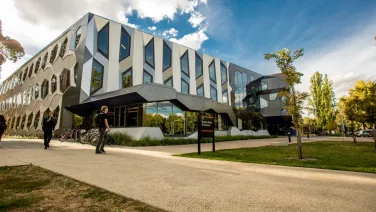
The achievements of the School on its 50th anniversary are being celebrated throughout November 2017.

Researchers from ANU have developed a new way to synthesise bicyclic peptides, with major implications for future research into drug treatments for a range of diseases including cancer, viruses and bacterial infections.